Automatic Transmission In Indian Hatchbacks


Automatic Transmission was something unknown to Indian cars before the 1990s. In recent times there have been many global brands offering automatic transmission units in basic cars in India. One of the primary reasons for this may be increase in road traffic across metropolitans and other cities which make it tedious to drive geared cars in India. Automatic transmission units either give complete relief or partial relief from the act of pushing the gear lever around. There are various types of transmission assembly which work using different principles and behave differently to aid various driving styles. Some of the hatchbacks currently available in Indian market which have automatic transmission systems are listed below.

Hyundai i10

Hyundai i10 Automatic
Hyundai i10 the cousin of Santro came to India in 2007 as a basic hatchback. The model is doing as well as Hyundai Santro, serving a segment higher with more options. The car which is currently available in market with the 1.2L Kappa engine has a 4 gear automatic transmission system which allows the driver to pick between D, 2 and L modes. In D mode the gears change automatically from 1 to 4. In 2 mode the gear shifting is limited to 1stand 2nd gears which would be useful for driving on steep roads and while parking in garage. Other positions on the lever have parking (which lets the gear to get locked when car is parked), neutral and reverse options. The engine makes use of Variable Timing Valve Train technology to deliver higher efficiency and smooth power delivery to wheels through automatic transmission unit.

Maruti Suzuki A Star
Maruti A Star Automatic

Maruti Suzuki A Star, a car known for its fuel efficiency across the world is available in 4 speed automatic transmission unit. The car uses a similar gear lever shift mechanism as in Hyundai i10 where the gear lever lets the driver pick between gear limits. The unit is coupled to 1.0L K series engine which delivers 68 hp of power. The combination of a smaller engine and an automatic transmission unit means high fuel economy and a comfortable drive.

Honda Brio
Honda Brio automatic


Honda Brio, the compact hatchback from Japanese auto major got its automatic transmission on Indian shores in 2012. A five speed gear box which has a torque converter is used in the car. With more number of gears the car gives one extra mode for driving. The D mode changes gear to the fullest extent starting from 1. The D3 mode keeps the gear limit within 3 which would be useful in busy roads. All other modes remain the same like in Hyundai i10 and Maruti A Star.

Mahindra Reva i
Reva i Automatic

The electric powered car from Bangalore based company has received both positive and negative responses globally. The car uses a completely automatic transmission system which does not have a gear lever too. The car uses lead acid batteries to power its wheels and AC. The eco friendly car drives at a maximum speed of 80 km/hr.

Volkswagen Beetle
Volkswagen beetle Automatic

One of the cars that have been in production lines for more than 60 years in continuous is still fancied by people from many parts of the world. The Volkswagen Beetle that came back to Indian grounds few years ago has a six speed tiptronic transmission system where the driver can intervene automatic transmission process and change gears as per his mood and road needs. The transmission system works automatically if there is no shift from the driver. This system is mated to a 2.0L 114 bhp engine which generates a torque of 172 Nm. Driving this car is a real pleasure in the presence of smoothly shifting gears.

With increase in competition among automobile brands more and more Indian cars could get automatic transmission system since it is a convenience feature. Many saturated markets like USA have these systems and other technological features in most of their models. Cars in India are slowly growing to these levels where companies are expected to provide more features within the stated price tag.

Fall Wrap-Up & the "Biggest Day in Wyoming Bouldering"


Dearest readers, its been quite some time.  I've come to the firm conclusion that never again will I take 20 credit hours for the rest of my college career.  It takes valuable time away from the things that are really important in life...namely rock climbing and blogging about rock climbing.

...

Its not like I haven't gotten out at all, just not quite as much as I would've liked to.  I did have a pretty great Vedauwoo season though.  I finally committed myself to manning up and getting on some harder routes- Friday the 13th (5.10a) and Plumbline (5.9+) became my major objectives this Fall.  I only went to Plumbline once, and came within 5 feet or so of sending before I had to hang on gear.  This caused me to realize that maybe it wasn't necessarily my climbing strength that kept me from sending that day, but my lead head yet again.  I placed 8 cams in the route, which is 35-40' tops, quite the monumental waste of energy!  Lesson learned, I tried to be a little more sparse with gear placements on my first redpoint attempt on Friday the 13th. 

 My first time on the route, I practically aided my way up, and with all my beta perfectly worked out, I went for it again with high hopes to send.  My hopes were shut down, but not entirely.  In fact, I was able to climb the entire first half (aka the 5.10a half) completely clean, which is a pretty big landmark for me.  Again, more efficient gear placement seems to be my key to sending harder crack climbs.  In stark contrast, I've felt more comfortable than ever on easier cracks; I even led both pitches of Ed's Crack (5.7) on only 2 pieces of pro...may as well have soloed it!

Plumbline


 Friday the 13th

 Rebecca topping out Ed's Crack 

Working as a UW route setter has also been great this year.  This year will be our last season with our current wall, which will be torn down and replaced with a free standing column with lead routes and 200 square feet of bouldering space!  This also marks the 10th anniversary of the Friday Night Bouldering Series, which we hope to continue once the new wall is completed.

Looking fresh for the Costume Comp

Mikey Mills throwin' down

But now for the real business...

I was only able to make it out to Neverland 3 times this Fall, and fortunately, winter still seems to be holding off.  I was still rather out of shape our first trip, and didn't really send anything.  We went to the grove, where I came quite close to finishing a 30' 5.12a traverse Davin put up, but the ever persistent pump struck me yet again shortly after the crux sequence.  I also felt out Downtown Stickworm Town (V6/7), which I know I can send right now, just a matter of getting back out there.

 The traverse problem

Our next venture a few weeks later was much more successful.  After a long hard night of post-comp partying, I was a little concerned that my performance would be rather lackluster, which it was initially.  With an arctic wind blowing across the  Neverland landscape, Bryan, Davin, Nathan, and I fled to the Finger Paint Cave, which remains exposed to the sun and sheltered from the wind in the morning hours.  After a few hungover attempts, I sent Triangle Man (V3) and almost instantly felt ready to climb hard.  Nathan and I then walked a little ways right of the cave and cleaned two more warm-ups while Davin and Bryan worked the 2 Finger Paint Cave projects.

 Nathan on Triangle Man
 
 One of our new warm-ups- V3ish

Davin working Finger Paint (V11), which he finished the next week

With plenty of time left in the day and the relentless wind still blowing, we headed to the quiet caves and recesses of Douthitt Gap, where Nathan and I repeated Cold Wind Blows, which we confirmed to be V4.  Nearby, Bryan put up a fun and powerful prow which I also repeated and called V5, while Davin established Firecracker (V8) on the same boulder.  Feeling pretty strong, I was actually able to work through the first few moves of Firecracker, which gave me quite a bit of incentive to start projecting more problems in the V8 range.

We finished off the day in the massive cave that we visited back in March when Neverland was but a frozen hell on Earth.  Nathan established a really fun and long V3 which finishes on a jug slightly below the the lip of the cave.  I repeated it, Bryan gave a half assed attempt in his approach shoes, and we called it a day, everyone thoroughly worn out.

 Cold Wind Blows

 Bryan on Firecracker

 Cave problem

Finally last weekend, we returned to Douthitt, but this time with an epic crew: Evan, Meredith, Bart, Joyce, Nicole, Rebecca, Tad, Kyle, Brandon, Josh, Josh's Girlfriend (I'm not good with names!), Davin, and I.  Somewhat surprisingly, it was a lot of fun to have everybody out there at once.  It was a really positive group which divided into a few smaller ones so no single problem was ever overwhelmed.

Posse in effect

  About half of us started the day at the classic Columbine Cave, which I had never climbed before.  The Widow and the Fly (V4) had been on my tick list for a while so I was excited to get on it.  I sent it in 3 goes after warming up on the easy V2 just to the left of it.  Tempted to work So Sexy So Soon (V7) which traverses almost the entire cave, I opted to head downhill to a long boulder where the rest of the group had been cleaning new lines.

 The wind polished Columbine Cave

The Widow and the Fly

At the other boulder, some 6 problems were clean and established, 3 of which I repeated.  The furthest left one is a tall wind polished face with excellent crimps and good feet, about V2.  On the right side, a crimpy traverse and a short, thuggy line with cool pockets and a sidepull went up, both in the V3 range.  Off to the side, Davin finished a short funky problem with hard liebacks and fat pinches- Vhard.

Nicole on the traverse

Bart on the pocketed route

Around noon, Evan, Meredith, and I walked the hillside to scope out new lines.  We found a few really cool ones on the very top of the hill, but were pretty enticed by a beautiful wind polished face just above where we had been all day.  Being on the backside of the notorious When Black Mambas Attack (V11), we figured it must have already been done long ago, yet Davin informed us that it was still a virgin line.  Overly excited to put up the next Neverland classic, Evan and I furiously cleaned the boulder and worked out beta. The first 3-4 moves are the crux, consisting of half pad crimps and delicate foot placement, which leads to a cruisy V2ish finish.  After some 45 minutes, Evan beat me to the FA of Copperhead (V5).  I sent shortly after he did, and its undeniably the kind of boulder problem that just puts a smile on your face- a true classic.

 The crux sequence of Copperhead

The big, but casual topout

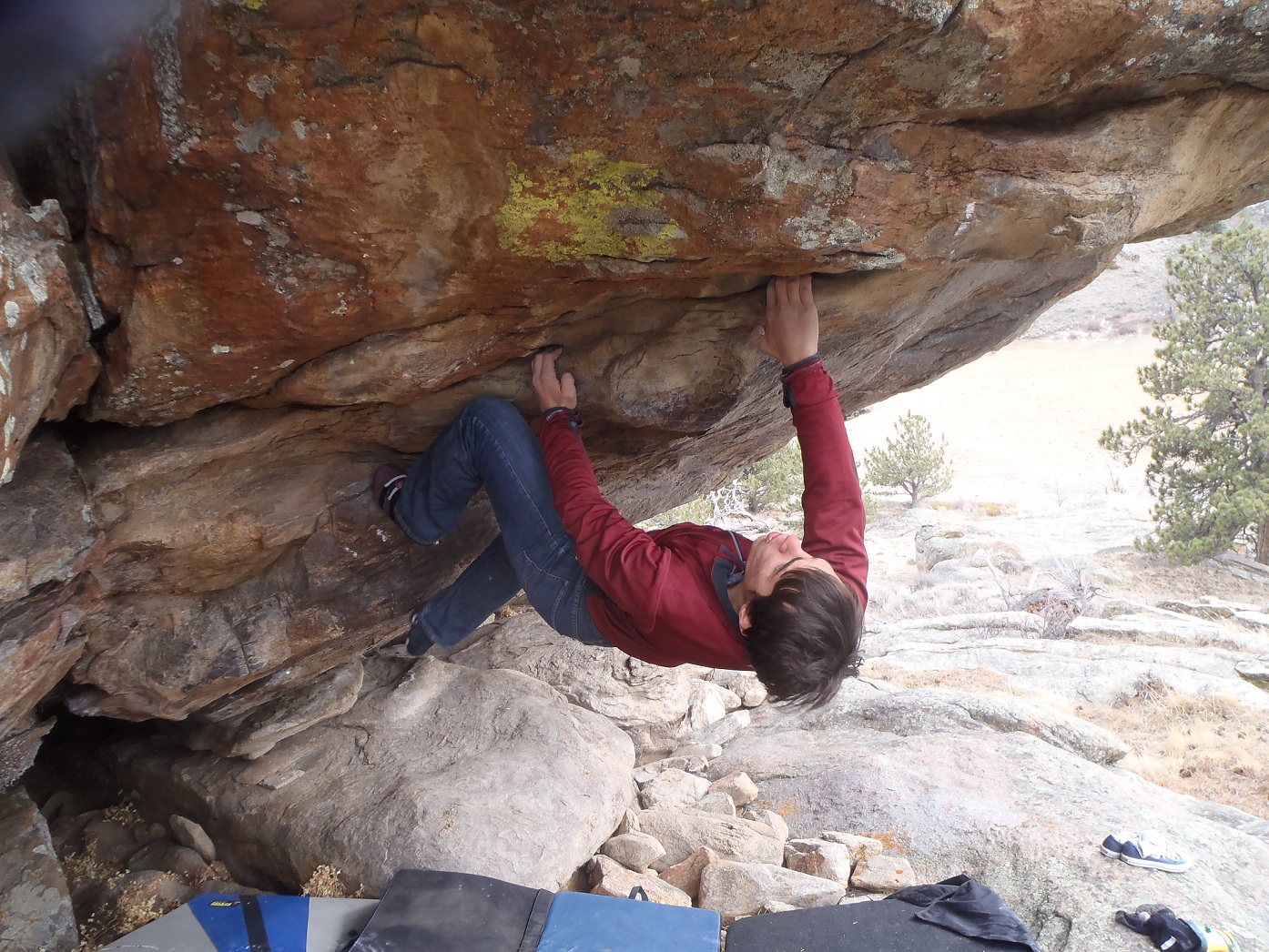
After the excitement of Copperhead, we walked up the hill to check out a few more nice moderates that went up on a tall black granite face. About half of the group then left for the day and the rest of us headed across the gap to the big cave area.  There, Davin showed off a few great hard roofs that he finished the week before, while Tad and I worked on a fun and powerful new line just right of the roofs.  Unfortunately, the topout was horrifically wet from recent snowmelt, and we hopelessly flew off of it time and time again- it will go quick next time when its dry.

With so many people newly exposed to the vast amounts of high quality rock and the extra long season, it looks like Neverland may finally start getting the attention it deserves from the Laramie climbing community.  


Essai routier: Mitsubishi RVR 2013


C’est mon deuxième contact avec le Mitsubishi RVR.  Le premier, survenu il y a un peu moins de deux ans, avait été plutôt tiède car le RVR n’avait pas su m’émouvoir avec son design intérieur plutôt ordinaire, des matériaux trop plastiques et des performances décevantes.  Qu’en est-il deux ans plus tard?

D’abord, le Mitsubishi RVR 2013 nous gratifie d’une très légère mise à jour stylistique.  Pour ceux qui manque de perspicacité, c’est au niveau des phares antibrouillard et des feux arrière que ça se passe.  Il y a deux ans, Mitsubishi m’avait fait essayer la version la plus dépouillée du lot, ce qui n’avait pas aidé sa cause.  Cette fois-ci, c’est la plus équipée qui se retrouve dans mon entrée.  Le Mitsubishi RVR 2013 est offert en trois versions et deux modes d’entraînement soit les ES 2WD, SE 2WD, SE 4WD et GT 4WD.  Deux précisions à faire sur cette nomenclature : d’abord, tout comme pour la Lancer, le RVR est identifié à l’arrière « AWC » pour All-Wheel-Control.  Dans mon esprit, il ne s’agit que d’un truc publicitaire puisque partout ailleurs sur ces véhicules, on parle plutôt de 4-Wheel-Drive.  Deuxièmement, même si la version la plus huppée se paie le luxe de retenir les lettres « GT », mécaniquement, elle n’offre rien de plus que les autres versions si ce n’est des pneus de 18 pouces.  Précisions effectuées!


La première constatation lorsque j’ai pris place à l’intérieur, c’est la différence entre le modèle de base essayé précédemment et celui-ci.  Les matériaux ont l’air de meilleure qualité (le sont-ils vraiment?) et même les molettes de climatisation qui semblaient sorties tout droit d’un Dollarama dans le véhicule de base semblent plus solides dans le GT.  Plusieurs éléments du modèle de base sont remplacés dans ce modèle.  Par exemple, le petit ordinateur de bord situé entre les deux cadrans offre un affichage à cristaux liquides beaucoup plus « léché » que dans la version régulière.  Pour ce qui est des données affichées, c’est du pareil au même et Mitsubishi n’a pas encore trouvé le moyen de lui faire retenir la moyenne de consommation d’essence plus de quatre heures.  Tout le bloc central est consacré à ce système d’infodivertissement dont les commandes sont tout de même assez faciles à utiliser.  Il faut souligner que cette chaîne Rockford-Fosgate offre 710 watts de son avec ses huit haut-parleurs plus un énorme caisson de graves dans la soute à bagages.  Le son est très bon autant pour la radio que pour les CD, DVD et iPod.  La navigation GPS est assez précise et facile à programmer.  Il y a aussi une caméra de recul et un disque dur de 40 Go pour y « entreposer » votre musique.  Le « hic », c’est que cet ensemble vous arrachera 3 500 $ de votre portefeuille.  Ouch!  La climatisation automatique fait bien son travail avec un ventilateur qui n’est pas trop bruyant.  Plus bas encore, un vide-poche que j’ai confondu avec un porte-gobelet.  Les porte-gobelets sont plus loin derrière le levier de vitesses  et le commutateur des quatre roues motrices.  Dans le petit coffre, entre les deux sièges, Mitsubishi a logé la prise USB et une autre prise 12V.  Dans le modèle GT, le toit panoramique est de série.  C’est vraiment agréable de rouler avec cette vitre au-dessus de la tête des occupants avant et arrière.  C’est une impression de décapotable sans le vent dans les cheveux.  Le soir venu, il y a des petites lumières LED de chaque côté de la vitre.  C’est… charmant!  Un seul reproche fait par un propriétaire de RVR que j’ai rencontré : c’est toute une affaire que de nettoyer cette vitre car elle est très grande!  À chacun ses petits problèmes.

La visibilité ne pose pas de problème vers l’avant.  Vers l’arrière, on peut souligner les grands rétroviseurs et la caméra de recul mais la vue de ¾ arrière offre une visibilité médiocre pour changer de voie sur l’autoroute.  La soute à bagages offre des dimensions respectables.  On peut l’agrandir grâce à la banquette divisée 60/40 et Mitsubishi a eu la bonne idée d’intégrer une trappe à skis dans la banquette.  On vous offre donc le meilleur des deux mondes. 

Sous le capot, le sempiternel moteur quatre cylindres de 2,0 litres qui produit 148 chevaux et 145 lb-pi de couple.  Pour ce qui est des transmissions, on parle d’une manuelle à cinq rapports ou d’une transmission à rapports continuellement variable CVT.  Dans le modèle GT, celle-ci offre aussi un mode manuel à six rapports avec palettes de changement de vitesses au volant.  La puissance de ce moteur ne casse rien et la transmission CVT, malgré sa bonne volonté, ne peut faire de miracle.  Vous pouvez toujours jouer avec le mode manuel pour aller chercher tous les chevaux disponibles mais vous verrez qu’ils se font rares.  En fait, je me demande pourquoi Mitsubishi n’implante pas le 2,4 litres plus puissant qui fait vraiment la différence dans la nouvelle Lancer SE-AWC.  Peut-être parce qu’il jouerait alors dans les plates-bandes du Outlander.  Caractéristique à souligner : les freins sont à disques aux quatre roues sur tous les modèles, ventilés à l’avant et pleins à l’arrière.  Tous les modèles roulent sur des pneus de 16 pouces sauf le modèle GT à l’essai qui, lui, utilisent des 18 pouces pour vous offrir une meilleure tenue de route que les autres modèles.  La suspension ne favorise pas la performance et c’est pour cette raison que les pneus de meilleure qualité de la GT aident grandement au plaisir de conduire.

Voilà un VUS qui a plusieurs personnalités.  En version de base, essayé en 2011, le plaisir de conduite était limité et la qualité des matériaux étaient moyenne.  En version GT, la plus équipée essayée cette fois-ci, l’agrément de conduite se bonifie.  Le moteur n’est pas plus puissant mais le confort et les pneus de 18 pouces ajoutent un je-ne-sais-quoi qui nous fait mieux apprécier le véhicule.   Le problème, c’est que lorsqu’il faut choisir le modèle le plus coûteux pour l’apprécier, plusieurs concurrents se pointent le bout du nez pour vous épater.  Dans cette catégorie, la lutte est féroce.  Bonne chance au Mitsubishi RVR!


Questions, commentaires, opinions?  Venez discuter du Mitsubishi RVR sur le forum de Passion Automobile en cliquant ici.

Essai réalisé précédemment : Mitsubishi RVR 2011

Conditions de l’essai

Réalisé du 9 au 12 octobre 2012 .
Journées de soleil et de pluie, entre 3 et 16 °C.
Modèle essayé : Mitsubishi RVR GT 4WD 2013
Prix selon www.mitsubishi-motors.ca (13 novembre 2012) :
·         ES 2WD : 21 895 $
·         SE 2WD : 24 195 $
·         SE 4WD : 27 595 $
·         GT 4WD : 30 895 $
Prix du modèle essayé : 34 198 $ + taxes
Distance parcourue : 311,2 km (64 % autoroute)
Consommation selon Ressources Naturelles Canada (2012):
·         Ville : 8,6 L/100 km
·         Route : 6,6 L/100 km
·         Émissions CO² : 3542 kg/année
Consommation dans la vraie vie: entre 8,5 et 9,0 L/100 km environ
Régime-moteur à 100 km/h : 2 000 tours/minute
Régime-moteur à 115 km/h : 2 300 tours/minute
Véhicule fourni par Mitsubishi Canada.
Photos prises à la Fédération des Caisses Populaires Des jardins à Joliette, Québec